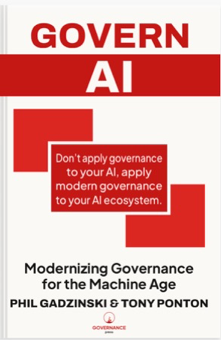
After Govern Agility, boards and leadership teams kept asking what AI does to governance. This is the answer: a practical guide to minimum required governance, so AI agents can scale safely alongside people.
Apply modern governance to your AI, not just AI to your existing governance
“AI changes almost everything about how work is conducted, but it does not change the fundamental necessity for robust governance. Instead, what changes is the nature of the governance itself, and it is this change, shifting from a system of “No” to an engine of Flow, that unleashes the true potential of AI and, in turn, makes your organisation more profoundly human.”
Tony Ponton Co-author, Govern Agility and Govern AI
21%of enterprises report a governance model mature enough for autonomous AI, while 74% plan to deploy agentic AI.Deloitte, State of AI in the Enterprise 202678%of business leaders lack strong confidence they could pass an independent AI governance audit within 90 days.Grant Thornton, 2026 AI Impact Survey93%of leaders and board directors see formal governance mechanisms as critical to rolling out AI.Governance Institute, AI Deployment and Governance 2026
Inside the book
Three ideas for governing at machine speed
1
Smart Boundaries
Guardrails (hard stops), guiderails (contextual heuristics) and a shift from human-in-the-loop to human-on-the-loop.
2
Mechanised Oversight
Governance as code, safe-action pipelines and intelligent guiderails that check work as it happens, not in committee.
3
Minimum Required Governance
Safe where it must be, flexible where it can be: proportional friction and escalation only when a boundary is breached.
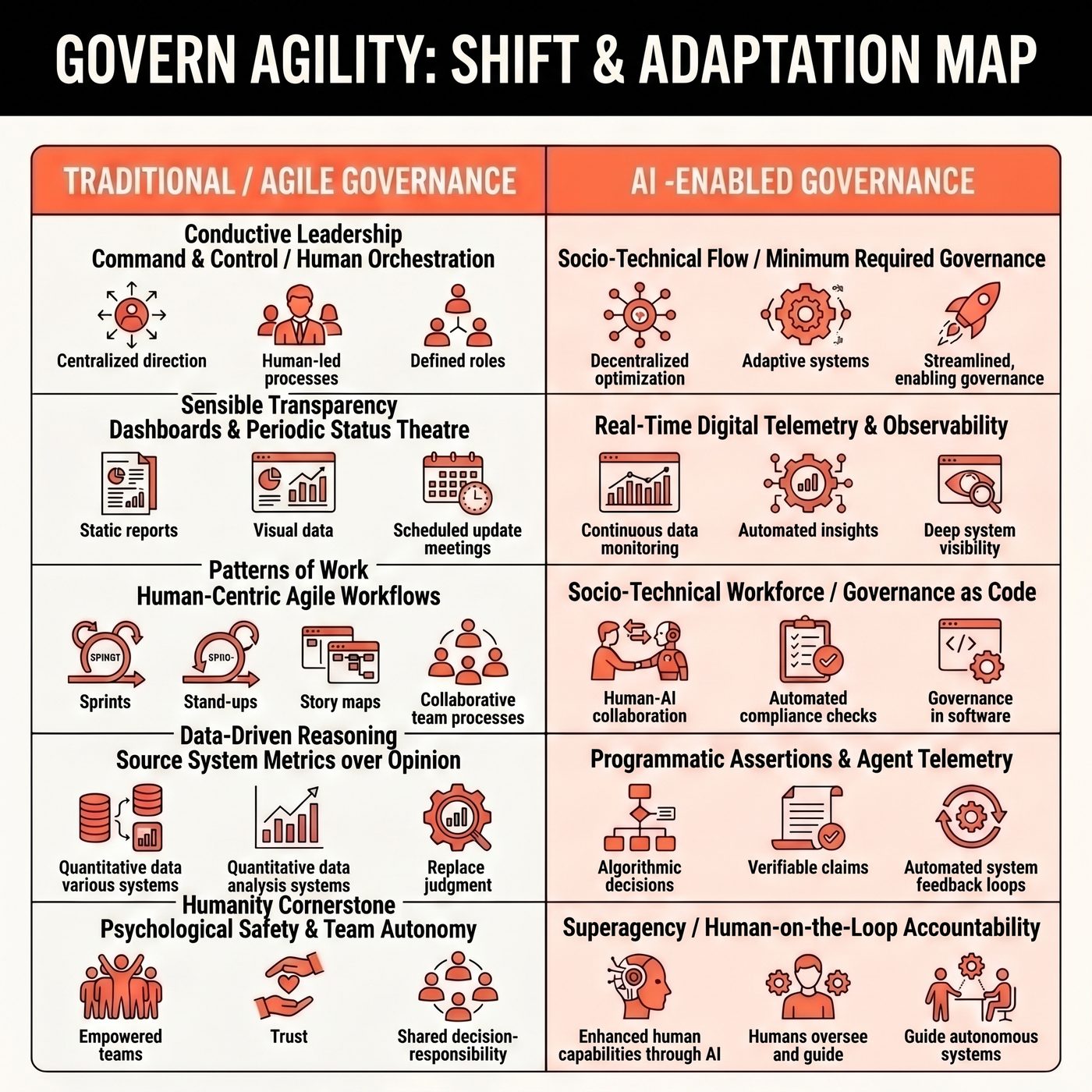
The Shift & Adaptation MapHow each stanchion moves from traditional and agile governance to AI-enabled governance: from command and control to human orchestration, from status theatre to real-time telemetry.
Beyond the book
Bring these ideas into your organisation
A keynote, a leadership workshop, or working with Tony and Phil directly.